
|

|
|
|
|
The absolute positional accuracy of source coordinates in Chandra observations is estimated measuring the angular offset between Chandra X-ray source positions and corresponding optical/radio counterpart positions from accurate catalogs .
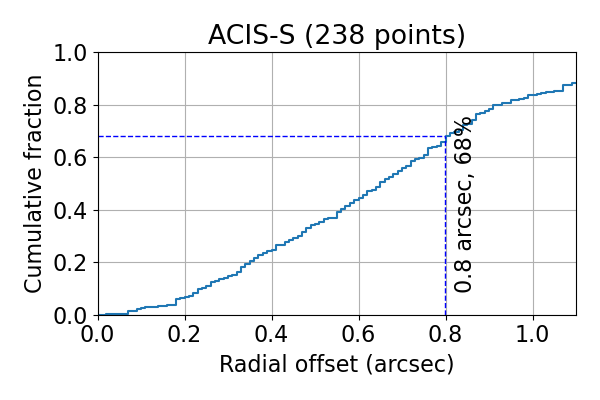
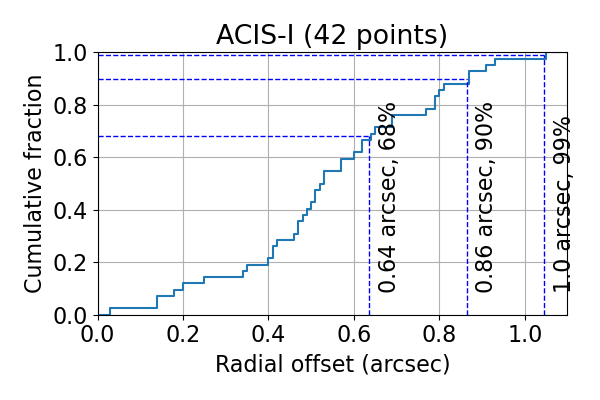
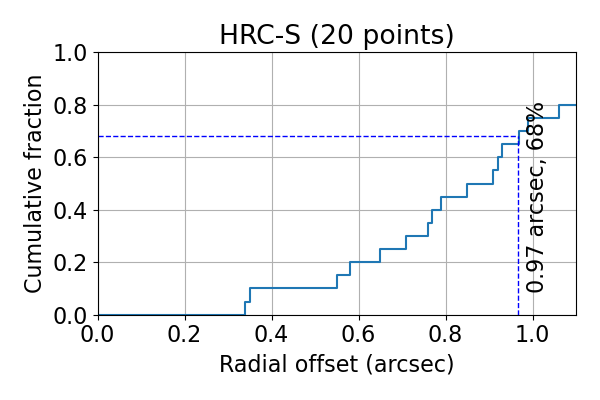
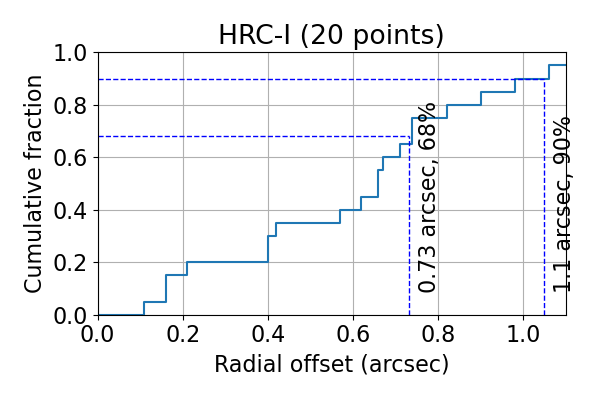
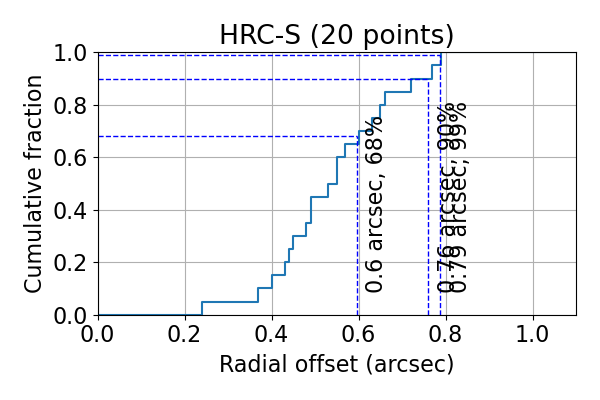
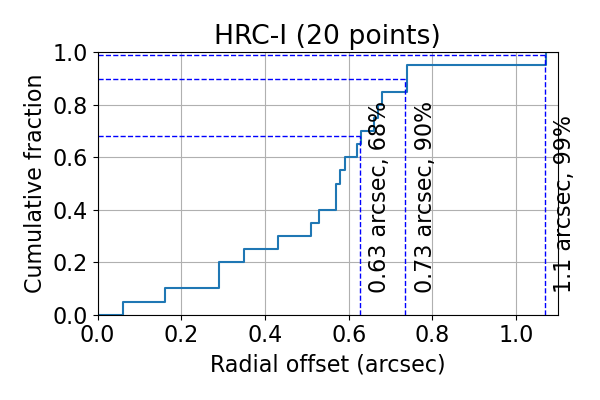
The overall 90% uncertainty circle of Chandra, based on observations between 2021-10-13 and 2026-10-13 X-ray absolute position has a radius of 1.17 arcsec. The 99% limit on positional accuracy is 1.80 arcsec. The worst case offset is 2.7 arcsec. Performance varies slightly between detectors.
These values apply to sources within 3 arcmin of the aimpoint and with the SIM-Z at the nominal detector value.
Unless otherwise stated, the figures in this page are based on observations between 2021-10-13 and 2026-10-13.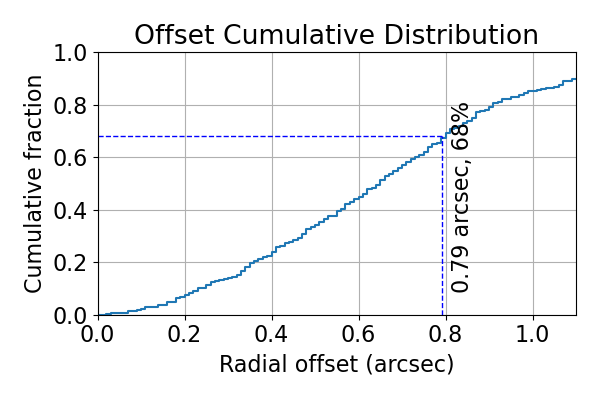
The four plots below show the cumulative distribution of aspect offsets for observations in the last 5 years. The aspect offset is the distance from X-ray source centroid to the accurately known position of the optical or radio counterpart.
The time-history of offsets for recent Chandra observations is shown below.
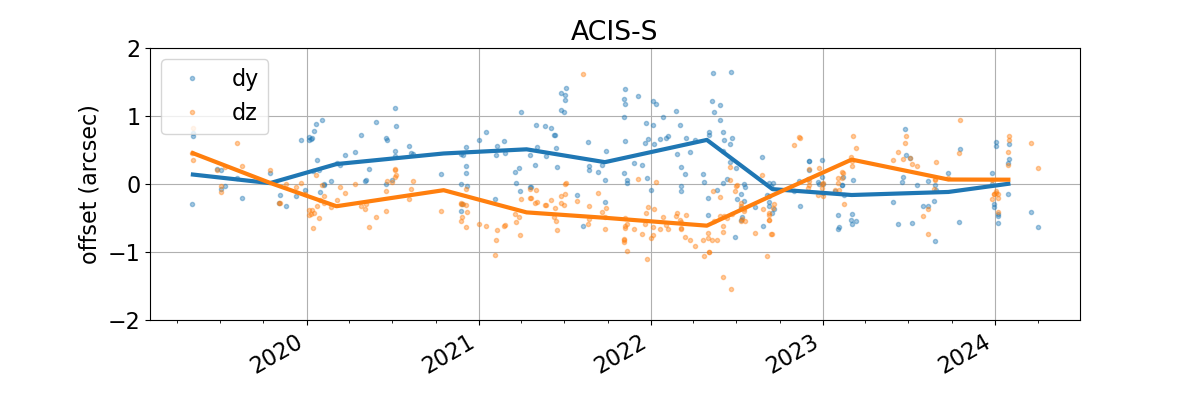
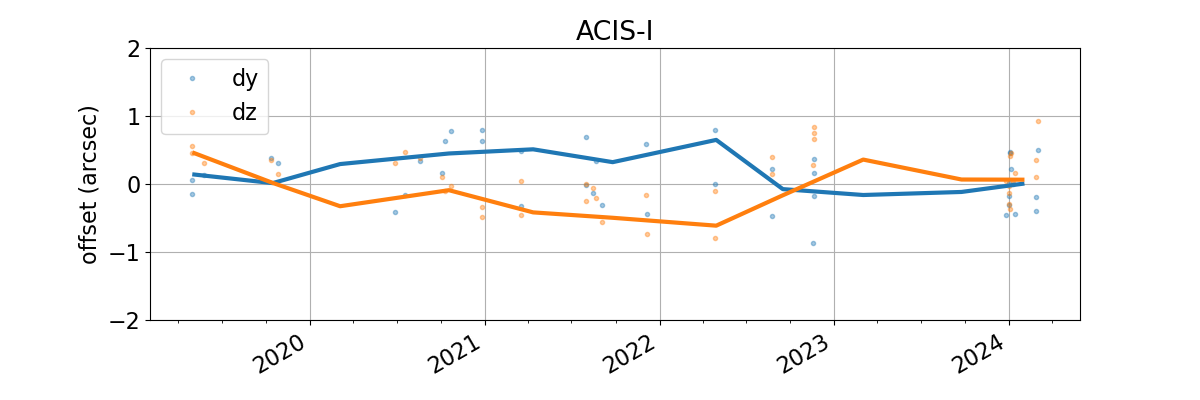
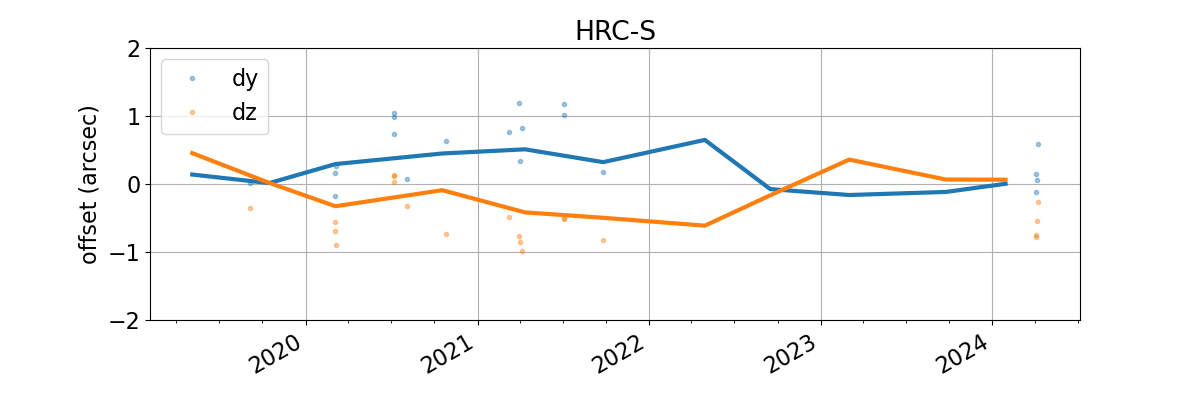
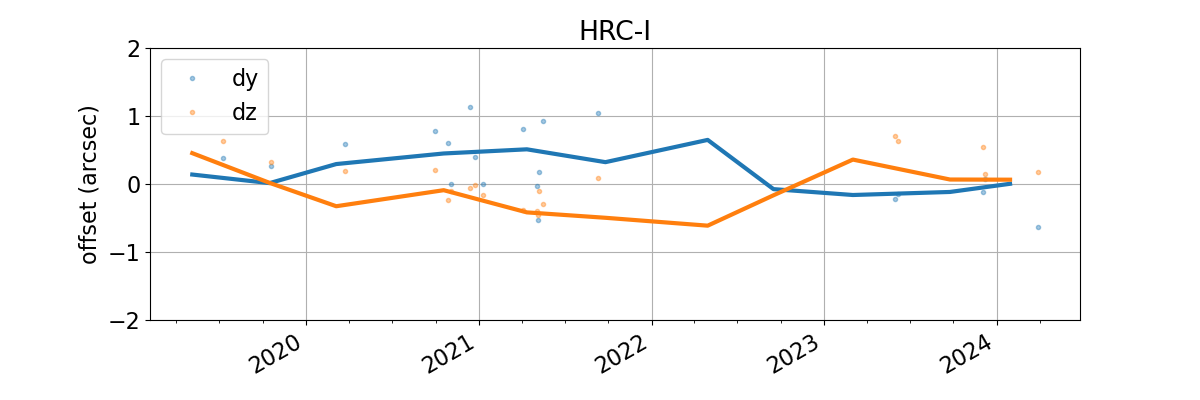
The previous section shows the distribution of angular offsets of observations currently in the archive. As the alignment is calibrated based on historical data, observations that have been processed already are not updated. The absolute pointing in these observations can improve if the observations are reprocessed with the latest calibration.
This section shows the distribution of angular offsets that would result from reprocessing all observations with the latest calibration.
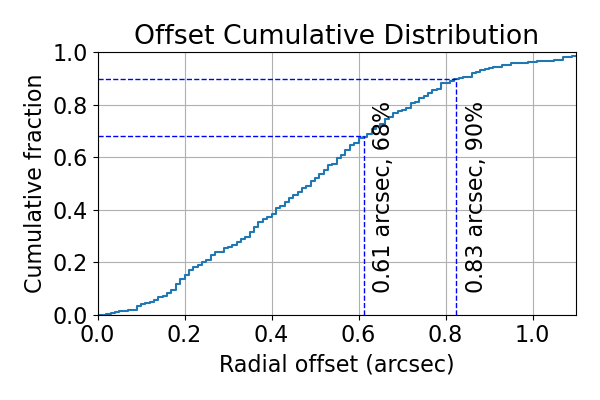
The four plots below show the cumulative distribution of aspect offsets for observations in the last 5 years. The aspect offset is the distance from X-ray source centroid to the accurately known position of the optical or radio counterpart.
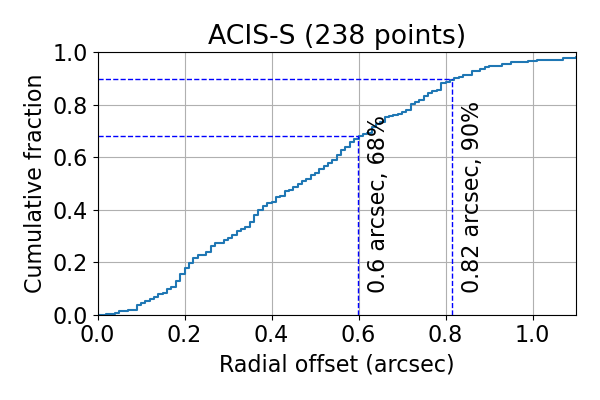
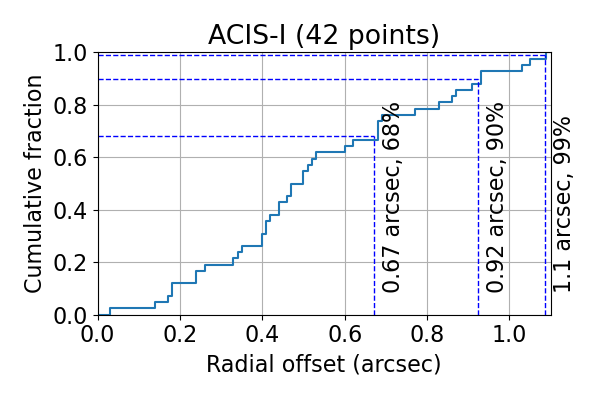
The time-history of offsets for recent Chandra observations is shown below.
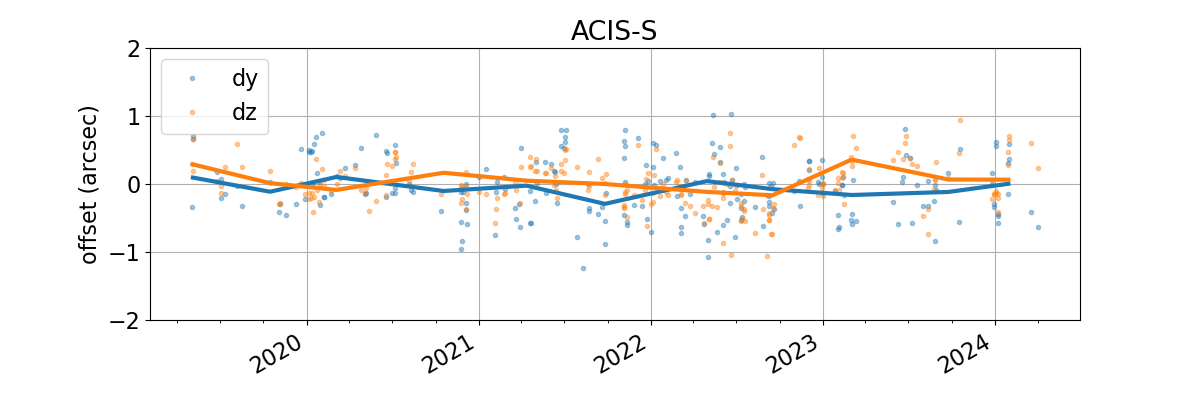
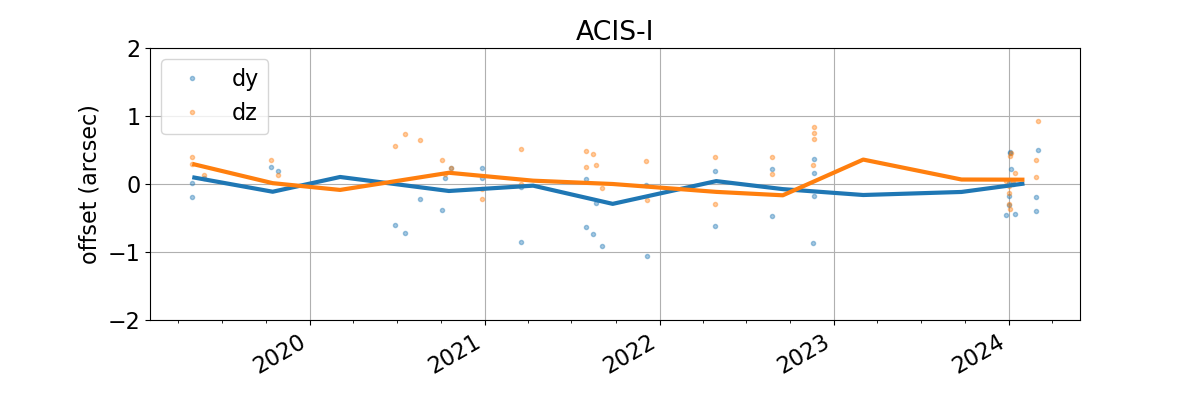
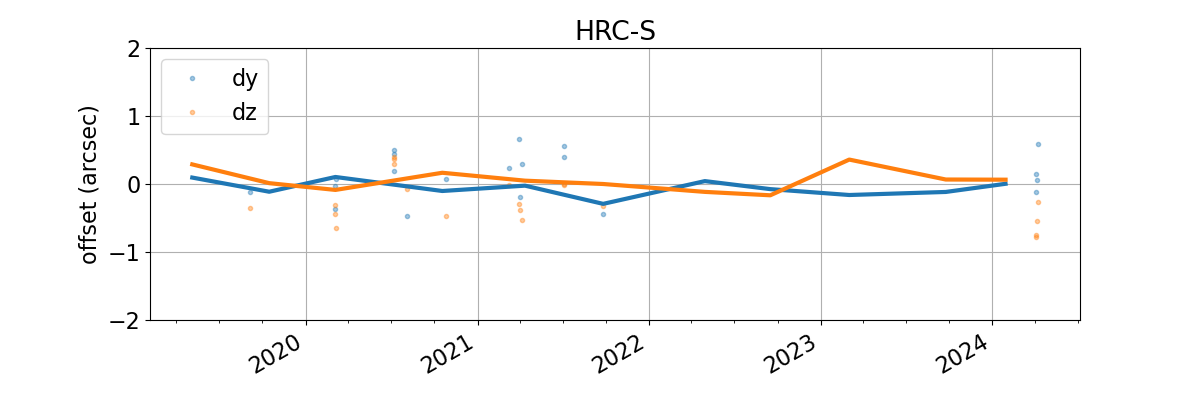
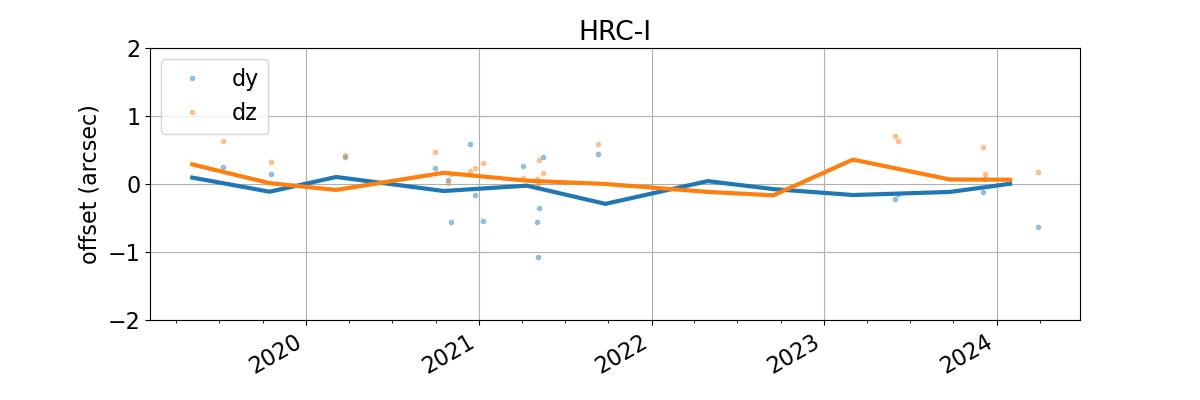
The above plots show the offsets between Chandra X-ray source coordinates and the corresponding optical or radio coordinates. The offsets are derived using a dataset comprised of observations from the last 5 years, selected for quality according to the criteria described in this section.
Only observations with the following characteristics are considered:
obs_mode==POINTING readmode==TIMED and dtycycle==0. During the source detection process, the detected sources fulfill the following requirements:
SNR > 5 An X-ray source matches an optical/radio source if the offset is less than 3 arcsec. If a source is matched in more than one catalog, the most accurate catalog is used, in the following order of preference: ICRF2, Tycho2.
The offsets \((\Delta Y, \Delta Z)\) are specified in the Chandra body coordinate system, since they reflect drifts in hardware alignments. The origin of this coordinate system is chosen to be the nominal pointing of the observatory for the observation \((RA_{nom}, DEC_{nom}, ROLL_{nom})\). At a spacecraft roll angle of 0.0 degrees, \(\Delta Y\) corresponds to an offset along Right Ascension, and \(\Delta Z\) corresponds to an offset along Declination. The exact equation is: \[ \begin{pmatrix} \Delta Y \\ \Delta Z \end{pmatrix} = \begin{pmatrix} \cos(ROLL_{nom}) & -\sin(ROLL_{nom}) \\ \sin(ROLL_{nom}) & \cos(ROLL_{nom}) \end{pmatrix} \begin{pmatrix} \cos(\text{DEC}_{nom}) \Delta RA \\ \Delta \text{DEC} \end{pmatrix} \]
It is important to note that observations on ACIS or HRC-S at large off-nominal SIM-Z can suffer additional residual aspect offsets of up to 1.5 arcsec. This is due primarily to distortion of fid light images by the retroreflector collimator in the fiducial transfer system. HRC-I observations at large off-nominal SIM-Z can have residual aspect offsets of up to 3 arcsec due to the fid light distortion as well as a possible rotation of the detector relative to the geometry assumed in processing.
Sources which are at HRMA off-axis angles greater than 3 arcmin have additional offsets due to PSF blurring and asymmetry. A quick rule of thumb in this case is that the uncertainty in absolute astrometry is roughly 1/4 of the 50% encircled energy radius at the corresponding off-axis angle. This is based on the data tables available in the memo Plate Scale and Relative Chip Postions. A more accurate determination of uncertainties could be made using raytrace simulations with MARX or ChaRT
For old archival data it should be noted that ACIS observations taken in 1999, and particularly before ~November 1999 could suffer larger offsets. Shortly after launch the alignment drifted rapidly due to outgassing of the ACIS mount tabs, and the calibration does not account for this effect.
The new alignments are based on a major re-analysis of aspect offsets for all detectors since launch. Based on a decaying exponential fit to offsets (common to all four detectors), the alignment shifts have been extrapolated out to 2002-12, which should reduce future offsets. The details can be found in the technical note ECR: Update CALALIGN align matrices. The new alignments also include correction terms which improve absolute aspect for some ACIS-I and HRC-I observations done with an off-nominal SIM-Z position. The details can be found in the technical note ECR: Create CALALIGN coefficients to correct fid positions based on SIM-Z offset
 |
The Chandra X-Ray
Center (CXC) is operated for NASA by the Smithsonian Astrophysical Observatory. 60 Garden Street, Cambridge, MA 02138 USA. Email: cxcweb@head.cfa.harvard.edu Smithsonian Institution, Copyright © 1998-2004. All rights reserved. |