


Using our two independent methods, we investigated the effects of
Compton scattering on the emergent spectra of three pure H white
dwarf models. These were: models appropriate for the well-known DA
white dwarfs Sirius B (assuming
 K,
K,  ) and HZ 43 (
 K,
K,  ), together with a significantly hotter
model with
), together with a significantly hotter
model with
 K and
K and  and
and  . These
models cover the effective temperature range relevant to pure H DA
atmospheres and specifically address the question of whether Compton
scattering might be relevant to the
X-ray bright DA white dwarfs Sirius B and HZ 43 that are central to
the low-energy calibration of Chandra (Pease et al., 2003).
. These
models cover the effective temperature range relevant to pure H DA
atmospheres and specifically address the question of whether Compton
scattering might be relevant to the
X-ray bright DA white dwarfs Sirius B and HZ 43 that are central to
the low-energy calibration of Chandra (Pease et al., 2003).
The results of our calculations from both methods are presented in
Figures 2-5. In Fig. 2a the
spectra of the model atmosphere for the DA white dwarf HZ 43 (
K, ) computed using Method 1 with (solid
line) and without (dashed line) Compton effects are shown. We also
calculated a non-LTE model atmosphere for HZ 43 using the code PRO2 (Werner et al., 2003) and computed the radiation transfer
equation with Compton scattering (3) using this non-LTE model
atmosphere structure. The corresponding spectra are shown in
Fig. 2a by the dotted line and by open circles.
![\includegraphics[width=1.0\columnwidth]{fig2.eps}](img104.gif) |
![\includegraphics[width=1.0\columnwidth]{fig3.eps}](img105.gif) |
Calculations using Method 2 in LTE are illustrated in
Fig. 3. The differences between Compton and Thomson
models in these calculations are very similar to the differences found
in Method 1 in Fig. 2a, and are significant only at
wavelengths  Å.
The flux in the
models with Compton scattering is smaller than the flux in the model
without Compton scattering by 0.5 % at 50 Å, 1.3 % at 40 Å, 7%
at 30 Å, and 40% at 20 Å
(Method 1). Similarly, model computations performed with Method 2
yield the following differences for HZ 43:
0.5 % at 50 Å, 1.4 % at 40 Å, 5% at 30 Å, and 56 % at 20 Å.
Å.
The flux in the
models with Compton scattering is smaller than the flux in the model
without Compton scattering by 0.5 % at 50 Å, 1.3 % at 40 Å, 7%
at 30 Å, and 40% at 20 Å
(Method 1). Similarly, model computations performed with Method 2
yield the following differences for HZ 43:
0.5 % at 50 Å, 1.4 % at 40 Å, 5% at 30 Å, and 56 % at 20 Å.
These results can be understood more clearly if we
consider the Comptonisation parameter  :
:
 is the relative photon energy lost
during one scattering event off a cool electron,
is the relative photon energy lost
during one scattering event off a cool electron,
 is the number of scattering events the photon
undergoes before escaping,
is the number of scattering events the photon
undergoes before escaping,
 is the Thomson optical depth,
corresponding to the depth where escaping photons of a given frequency
are created. The Comptonisation parameter is, then, a representation
of the influence of Compton scattering on the emergent spectrum:
significant Compton effects are expected if the Comptonisation
parameter approaches unity (Rybicki & Lightman, 1979). In
Fig.2b the dependence of on the
wavelength is shown. It is clear that the Comptonisation parameter is
very small down to 25 Å, and this is indeed reflected in the emergent
spectrum.
is the Thomson optical depth,
corresponding to the depth where escaping photons of a given frequency
are created. The Comptonisation parameter is, then, a representation
of the influence of Compton scattering on the emergent spectrum:
significant Compton effects are expected if the Comptonisation
parameter approaches unity (Rybicki & Lightman, 1979). In
Fig.2b the dependence of on the
wavelength is shown. It is clear that the Comptonisation parameter is
very small down to 25 Å, and this is indeed reflected in the emergent
spectrum.
Similar results were obtained for the DA white dwarf Sirius B
(assuming
K, ). The corresponding
spectra and the Comptonisation parameter are shown in
Fig. 4. The effective temperature of this star is smaller,
and the surface gravity is larger, therefore, Compton scattering is
even less significant than for HZ 43. We also calculated a non-LTE
model atmosphere for Sirius B using the PRO2 code and computed
the radiation transfer equation with Compton scattering (3)
using this non-LTE model atmosphere structure, as for HZ43. The
corresponding spectra are shown in Fig. 4a by the dotted
line and by open circles. Compton scattering changes only very
slightly the emergent spectrum at wavelengths below 20 Å.
In the Fig. 5 we present the spectra of the hot DA white
dwarfs model atmospheres (
 K, and
) with and without Compton scattering. It is obvious that Compton
effects are more significant for these hot DA models (especially with
low surface gravity) than for Sirius B and HZ 43, but visible effects
still do not occur for wavelengths
K, and
) with and without Compton scattering. It is obvious that Compton
effects are more significant for these hot DA models (especially with
low surface gravity) than for Sirius B and HZ 43, but visible effects
still do not occur for wavelengths  Å.
Å.
![\includegraphics[width=1.0\columnwidth]{fig5.eps}](img115.gif) |
 with wavelength (see
Eqn.
with wavelength (see
Eqn. 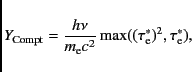
![\includegraphics[width=1.0\columnwidth]{fig4.eps}](img111.gif)
 K model
atmospheres with
and without Compton scattering. Solid lines correspond to model with
K model
atmospheres with
and without Compton scattering. Solid lines correspond to model with
 .
Softer high energy tails correspond to models with Compton effect. Run (b) of
Comptonisation parameter
.
Softer high energy tails correspond to models with Compton effect. Run (b) of
Comptonisation parameter