


Our second approach adopts the equation of transfer for absorption
and scattering presented by Sampson (1959) and Pomraning (1973, see
Eqn. (2.167)).
The equation of transfer can be expressed in the form
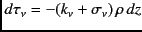 .
The variable
.
The variable  denotes the energy-dependent specific intensity,
and
denotes the energy-dependent specific intensity,
and  is the mean intensity of radiation.
Transformation of the equation of transfer by Pomraning (1973) to the Eq. 14 and the definition of required angular approximations for Compton scattering in a stellar atmosphere was outlined by Madej (1994); Madej (1991) and Madej et al. (2004).
Our equations and theoretical models of Method 2 use detailed differential
cross-sections for Compton scattering,
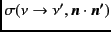 , which were taken from Guilbert (1981).
Cross-sections correspond to scattering in a gas of free electrons with
relativistic thermal velocities, and they are also completely valid at low
temperatures.
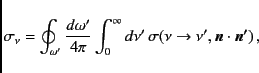
Differential cross-sections were then integrated numerically to obtain large
grids of Compton scattering opacity coefficients
, which were taken from Guilbert (1981).
Cross-sections correspond to scattering in a gas of free electrons with
relativistic thermal velocities, and they are also completely valid at low
temperatures.
Differential cross-sections were then integrated numerically to obtain large
grids of Compton scattering opacity coefficients 
 |
(15) |

 |
(16) |
 denotes the zeroth angular moment of the angle-dependent
differential cross-section, normalized to unity.
denotes the zeroth angular moment of the angle-dependent
differential cross-section, normalized to unity.
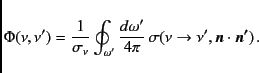
The scattering frequency redistribution function was introduced by
Pomraning (1973)--see Eqn. (7.95) of his book--and it represents
the normalized probability density of scattering from a given frequency
 to the outgoing frequency
  .
.
Note that Eq. 14 also includes stimulated scattering terms,
 , which ensure the physically correct
description of Compton scattering. The actual equations and
calculations used here strongly differ from those in Madej (1998).
The physics of Compton scattering used here is also
fundamentally different to Method 1. Note, that the latter method and that
of Madej (1998)
employ the well-known Kompaneets diffusion approximation to Compton scattering
kernels. The apparent difference between Methods 1 and 2 is that they
use either the differential Kompaneets kernel (Method 1) or kernels given
by integrals over the detailed Compton scattering profiles (Method 2).
, which ensure the physically correct
description of Compton scattering. The actual equations and
calculations used here strongly differ from those in Madej (1998).
The physics of Compton scattering used here is also
fundamentally different to Method 1. Note, that the latter method and that
of Madej (1998)
employ the well-known Kompaneets diffusion approximation to Compton scattering
kernels. The apparent difference between Methods 1 and 2 is that they
use either the differential Kompaneets kernel (Method 1) or kernels given
by integrals over the detailed Compton scattering profiles (Method 2).
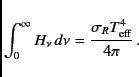
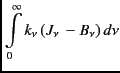
The equation of radiative equilibrium (the energy balance equation) requires
that
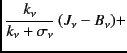
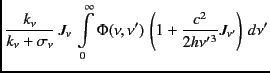
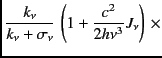
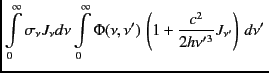
Computing derivatives of both sides of Eqn. 17 and using the
equation of transfer, Eqn. 14, one can obtain the alternative
energy balance equation
The computer code ATM21 used for the model calculations was
described in detail in Madej & Rózanska (2000) and
Madej et al. (2004). The structure of the code is based on the
partial linearization scheme by Mihalas (1978), in which
corrections of temperature  and the function
  are built into the equation of transfer. The high numerical accuracy
and very good convergence properties of the ATM21 code are vital
for the present paper, and allowed us to compute accurate spectra for
atmospheric parameters appropriate for the white dwarfs HZ43 and
Sirius B using Method 2, outlined above. These calculations supersede
less accurate X-ray spectra of HZ43 which were presented in the
earlier paper, Madej (1998).
are built into the equation of transfer. The high numerical accuracy
and very good convergence properties of the ATM21 code are vital
for the present paper, and allowed us to compute accurate spectra for
atmospheric parameters appropriate for the white dwarfs HZ43 and
Sirius B using Method 2, outlined above. These calculations supersede
less accurate X-ray spectra of HZ43 which were presented in the
earlier paper, Madej (1998).
For the present research, the ATM21 code included
numerous bound-free LTE opacities of neutral hydrogen and free-free
opacity of ionized hydrogen, which always remains in LTE.
No hydrogen lines were included in the actual computations. In each
temperature iteration the code solves the equation of hydrostatic
equilibrium to obtain stratifications of gas pressure  and density
 in the model atmosphere. After that the ATM21 code solves
the set of coupled equations of radiative transfer with implicit
temperature corrections and finds the stratification of in
the model atmosphere. The equation of radiative transfer was solved
using the
Feautrier method and the technique of variable Eddington factors
(Mihalas, 1978). Boundary conditions along the
in the model atmosphere. After that the ATM21 code solves
the set of coupled equations of radiative transfer with implicit
temperature corrections and finds the stratification of in
the model atmosphere. The equation of radiative transfer was solved
using the
Feautrier method and the technique of variable Eddington factors
(Mihalas, 1978). Boundary conditions along the  axis were
the same as in Method 1.
Explicit expressions for the temperature corrections, , can be
found e.g. in Madej et al. (2004).
axis were
the same as in Method 1.
Explicit expressions for the temperature corrections, , can be
found e.g. in Madej et al. (2004).



![$\displaystyle \int \limits _{0}^{\infty} \Phi (\nu ,\nu ^\prime) J_{\nu ^\prime...
...3
\exp \left[ -{{h(\nu - {\nu ^\prime }) }\over {kT}} \right]
\, d\nu ^\prime .$](img76.gif)
![$\displaystyle \hskip-30mm - \int\limits_{0}^{\infty} \sigma_\nu
\, d\nu \int\li...
...xp \left[ -{{h(\nu - {\nu^\prime }) }\over {kT}} \right]
\, d\nu^\prime = 0\, ,$](img91.gif)