


In our first approach, Compton scattering is taken into account in
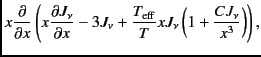
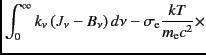
the radiation transfer equation using the Kompaneets operator
(Kompaneets, 1957):
 is the dimensionless frequency,
 is the variable Eddington factor,
  is the mean intensity of radiation,
  is the black body (Planck)
intensity,
is the black body (Planck)
intensity,
 is the local
electron temperature,
is the local
electron temperature,  is the effective temperature of WD,
and
is the effective temperature of WD,
and
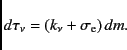
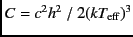 . The optical
depth
. The optical
depth  is defined as
 |
(4) |
 is the number density of all particles, and also
by the particle and charge conservation equations. We assume local
thermodynamical equilibrium (LTE) in our calculations, so the number
densities of all ionisation and exitation states of all elements have
been calculated using Boltzmann and Saha equations.
is the number density of all particles, and also
by the particle and charge conservation equations. We assume local
thermodynamical equilibrium (LTE) in our calculations, so the number
densities of all ionisation and exitation states of all elements have
been calculated using Boltzmann and Saha equations.
For solving the above equations and computing the model atmosphere we used a version of the computer code ATLAS (Kurucz, 1993; Kurucz, 1970), modified to deal with high temperatures; see Ibragimov et al. (2003) and Swartz et al. (2002) for further details. This code was also modified to account for Compton scattering.
The scheme of calculations is as follows. First of all, the input
parameters of the WD are defined: the effective temperature and surface gravity
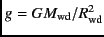 . Then a
starting model using a grey temperature distribution is calculated.
The calculations are performed with a set of 98 depth points
. Then a
starting model using a grey temperature distribution is calculated.
The calculations are performed with a set of 98 depth points  distributed logarithmically in equal steps from
 g cm
g cm to
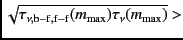
to  . The appropriate value of
is found from the condition
. The appropriate value of
is found from the condition
 1 at all frequencies.
Satisfying this equation is necessary for the inner boundary condition
of the radiation transfer.
1 at all frequencies.
Satisfying this equation is necessary for the inner boundary condition
of the radiation transfer.
For the starting model, all number densities and opacities at all
depth points and all frequencies (we use 300 logarithmically
equidistant frequency points) are calculated. The radiation transfer
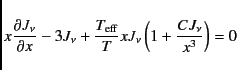
equation (3) is non-linear and is solved iteratively by the
Feautrier method (Mihalas, 1978, see also Zavlin & Shibanov 1991; Pavlov et al. 1991; Grebenev & Sunyaev 2002). We use the last
term of the equation (3) in the form
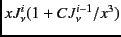 , where
  is the mean
intensity from the previous iteration. During the first iteration we
take
is the mean
intensity from the previous iteration. During the first iteration we
take
 . Between iterations we calculate the variable
Eddington factors
. Between iterations we calculate the variable
Eddington factors  and
and  , using the formal solution
of the radiation transfer equation in three angles at each frequency.
Usually 2-3 iterations are sufficient to achieve convergence.
, using the formal solution
of the radiation transfer equation in three angles at each frequency.
Usually 2-3 iterations are sufficient to achieve convergence.
We used the usual condition at the outer boundary
 |
(7) |
 is surface variable Eddington factor.
The inner boundary condition is
is surface variable Eddington factor.
The inner boundary condition is
 |
(8) |
 and
and
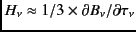 .
.
The boundary conditions along the frequency axis are
 Hz,
Hz,

 ) and
) and
 Hz,
Hz,
 ). Condition
(9) means that at the lowest energies the true opacity
dominates the scattering
). Condition
(9) means that at the lowest energies the true opacity
dominates the scattering
 , and therefore
. Condition (10) means that there is
no photon flux along frequency axis at the highest energy.
, and therefore
. Condition (10) means that there is
no photon flux along frequency axis at the highest energy.
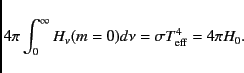
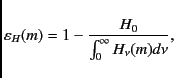
The solution of the radiative transfer equation (3) was checked
for the energy balance equation (5) together with the surface
flux condition
 |
(11) |
 |
(12) |
 is radiation flux at given depth.
This latter quantity was found from
the first moment of the radiation transfer equation:
is radiation flux at given depth.
This latter quantity was found from
the first moment of the radiation transfer equation:
 |
(13) |
 -iteration method,
modified for Compton scattering, based on the energy balance equation
(5). It is valid in the upper atmospheric layers. The
second one is the Avrett-Krook flux correction, which uses the
relative flux error, and is valid in the deep layers. And the third
one is the surface correction, which is based on the emergent flux
error. See Kurucz (1970) for a detailed description of the
methods.
-iteration method,
modified for Compton scattering, based on the energy balance equation
(5). It is valid in the upper atmospheric layers. The
second one is the Avrett-Krook flux correction, which uses the
relative flux error, and is valid in the deep layers. And the third
one is the surface correction, which is based on the emergent flux
error. See Kurucz (1970) for a detailed description of the
methods.
The iteration procedure is repeated until the relative flux error is smaller than 1%, and the relative flux derivative error is smaller than 0.01%. As a result of these calculations, we obtain the self-consistent WD model atmosphere together with the emergent spectrum of radiation.
Our method of calculation was tested on a model of bursting neutron
star atmospheres (Pavlov et al., 1991; Madej, 1991), and a model DA white
dwarf atmosphere with
 K,
K,  (Madej, 1994). Agreement with the earlier calculations is
extremely good. We illustrate the emergent spectrum from the
latter calculation in Fig.1.
(Madej, 1994). Agreement with the earlier calculations is
extremely good. We illustrate the emergent spectrum from the
latter calculation in Fig.1.
![\includegraphics[width=1.0\columnwidth]{fig1.eps}](img69.gif) |




 K and
K and