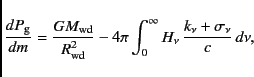
In both our numerical approaches, outlined below, we computed model atmospheres of hot white dwarfs subject to the constraints of hydrostatic and radiative equilibrium assuming planar geometry using standard methods (e.g. Mihalas, 1978). The equation of state of an ideal gas used assumes local thermodynamic equilibrium (LTE), and therefore did not include terms describing the local radiation field.
The model atmosphere structure for a hot WD is described by the
hydrostatic equilibrium equation,
 is opacity per unit mass due to free-free, bound-free and
bound-bound
transitions,
is opacity per unit mass due to free-free, bound-free and
bound-bound
transitions,  is the electron (Compton) opacity,
  is
Eddington flux,
is
Eddington flux,  is a gas pressure, and
  is column density
 |
(2) |
 denotes the gas density and
  is the vertical distance.
As is obvious from Eqn. 1, the structure of the atmosphere is
coupled to the radiation field and the structure and radiative
transfer equations need to be solved simultaneously under the
constraint of radiative equilibrium.
is the vertical distance.
As is obvious from Eqn. 1, the structure of the atmosphere is
coupled to the radiation field and the structure and radiative
transfer equations need to be solved simultaneously under the
constraint of radiative equilibrium.
In the Thomson approximation, in which no energy or momentum between
photons and electrons is exchanged,
 , where
 is the classical Thomson opacity.