


On the relevance of Compton scattering for the interpretation
of spectra of the LETGS DA white dwarf standard candles HZ43 and
Sirius B
An abstract submitted to the 6 Years of Science with Chandra
symposium by Kaastra, Lanz & Hubeny implies that pure hydrogen white
dwarf model atmospheres for the standard candles HZ43 and Sirius B
computed using Compton redistribution of scattered photon energies
lead to significantly different spectra in the LETGS bandpass than
models that employ the commonly adopted Thomson scattering
approximation. Since the LETGS calibration employs non-LTE model
atmospheres computed with classical Thomson scattering, the Kaastra et
al. abstract implies that this simplifying assumption is
inappropriate and might have lead to an erroneous calibration for
 Å where HZ43 and Sirius B are used. This memo
reports two independent calculations employing rigorous treatments of
Compton scattering that show differences between predicted spectra
of DA white dwarfs using Compton and Thomson scattering are completely
negligible for the interpretation of X-ray observations.
Å where HZ43 and Sirius B are used. This memo
reports two independent calculations employing rigorous treatments of
Compton scattering that show differences between predicted spectra
of DA white dwarfs using Compton and Thomson scattering are completely
negligible for the interpretation of X-ray observations.
The scattering of radiation by free electrons is one of the dominant
sources of continuous opacity in the atmospheres of hot white dwarfs.
Most model atmosphere calculations adopt the classical Thomson
isotropic scattering approach, whereby only the direction of photon
propagation changes as the result of a scattering event. More
rigorously, finite electron mass instead implies that both momentum
and energy exchange should actually occur.
The effects of Compton scattering on white dwarf model
atmospheres was first investigated in detail by Madej
(1994,A&A,286,515), who found that pure hydrogen models with
temperatures of  K show a significant depression of the X-ray
continuum for wavelengths
K show a significant depression of the X-ray
continuum for wavelengths  Å. Effects for models containing
significant amounts of helium, or helium and heavier elements, were
found to be much smaller or negligible, in keeping with expectations
based on the relative importance of electron scattering as an opacity
source as opposed to photoelectric absorption.
Å. Effects for models containing
significant amounts of helium, or helium and heavier elements, were
found to be much smaller or negligible, in keeping with expectations
based on the relative importance of electron scattering as an opacity
source as opposed to photoelectric absorption.
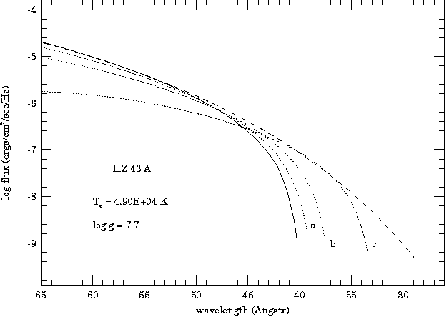
In a later paper (1998,A&A,340,617), Madej computed the effects of
Compton scattering for a model corresponding to the parameters of the
DA white dwarf HZ43. Representative results are reproduced in
Figure 1. Differences between Compton and Thomson
scattering model spectra are apparent for  Å, and grow
to orders of magnitude by 40 Å.
Å, and grow
to orders of magnitude by 40 Å.
The LETG+HRC-S effective area calibration is based on observed spectra
of HZ43 and Sirius B (Pease et al., 2003, Proc. SPIE,4851,157). Of
the components entering into the effective area, the HRC-S quantum
efficiency is by far the least well understood. It is treated
essentially as a free parameter in comparison of predicted and
observed spectra and adjusted to achieve agreement. Being a nearby
well-studies binary, the fundamental parameters of Sirius B are known
with particularly accuracy and model spectra of this object are used
to provide the effective area normalisation in the range within which
significant flux is detected--approximately 80-170 Å. Models for
the soft X-ray flux of HZ43 are then used to extend the HRC-S QE
calibration down to  Å. At shorter wavelengths neither
HZ43 or Sirius B have detectable flux and blazar continua are used
instead.
Å. At shorter wavelengths neither
HZ43 or Sirius B have detectable flux and blazar continua are used
instead.
Since The LETGS calibration does not depend on the absolute flux of
HZ43 for  Å, and Compton scattering effects are
expected to be smaller in Sirius B than in HZ43, the Madej (1998)
calculations suggested that Compton scattering is not relevant to the
use of DA white dwarfs as LETGS standard candles. This is the
assumption that has underlain the LETG+HRC-S effective area
calibration to date.
Å, and Compton scattering effects are
expected to be smaller in Sirius B than in HZ43, the Madej (1998)
calculations suggested that Compton scattering is not relevant to the
use of DA white dwarfs as LETGS standard candles. This is the
assumption that has underlain the LETG+HRC-S effective area
calibration to date.
Figure 1:
Reproduced from Madej (1998) Figure 3: ``X-ray spectra of various model atmospheres of the DA white dwarf HZ 43
A. The solid line is the Comptonized spectrum of a pure H model, whereas
the dashed line is the Thomson scattering spectrum. Note the X-ray
flux deficiency of the spectrum computed with Compton
scattering. Dotted lines present Comptonized spectra of H-dominated
atmospheres with He number abundance (line a), (line b), and (line
c), and with zero abundance of heavier elements.''
 |
Recently, an abstract was submitted to the 6 Years of Science
with Chandra symposium by Kaastra, Lanz & Hubeny that challenges
this conclusion. These authors state
...The new models take Compton scattering into account, a process
that is unimportant for the global UV/optical spectrum but which
diminishes the flux at the hardest X-rays significantly. Using these
models together with the observed LETGS spectra of both stars allows
us to refine the basic parameters of these stars as well as to
re-calibrate the effective area of the LETGS. In particular at the
longer wavelengths we find significant ( % ) differences with
the previously used effective area. ...
% ) differences with
the previously used effective area. ...
At the time of writing, no quantitative information on the influence
of Compton scattering on the analysis, as opposed to other possible
factors such as information regarding fundamental parameters, has been
provided by these authors.
In order to attempt to verify the 1998 Madej results, Valery
Suleymanov (Tuebingen) has performed independent calculations of
HZ43-like models with Compton and Thomson scattering. While his
approach employs the local thermodynamic equilibrium (LTE)
approximation, instead of the more general non-LTE approach known to
be required for accurate modelling of hot DA white dwarf atmospheres,
this does not affect in any significant fashion the predicted differences between Compton and Thomson scattering approaches. The
results of these calculations are illustrated in
Figure 2.
Figure 2:
Upper panel: spectra in the LETGS range computed by
Suleymanov (private communication) for Compton and Thomson scattering
using a model atmosphere with parameters appropriate for HZ43
(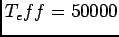 K and
K and  ). Lower panel: the two
Comptonisation parameters from the same calculations. These parameters
are significantly less than 1 throughout the relevant LETGS range and
demonstrate that Compton scattering cannot change the spectrum to any
large extent.
). Lower panel: the two
Comptonisation parameters from the same calculations. These parameters
are significantly less than 1 throughout the relevant LETGS range and
demonstrate that Compton scattering cannot change the spectrum to any
large extent.
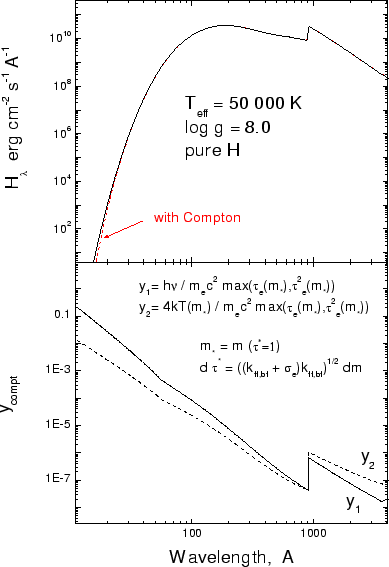 |
Examination of Figure 2 indicates that spectra computed
with Compton and Thomson scattering only begin to diverge for
wavelengths  Å or so. Since no flux from HZ43 is detected in
LETGS spectra at such wavelengths, the effects of Compton scattering
can be considered completely negligible.
Å or so. Since no flux from HZ43 is detected in
LETGS spectra at such wavelengths, the effects of Compton scattering
can be considered completely negligible.
Comparison of Figures 1 and 2, however,
reveal very large discrepancies for the predicted Compton scattering
flux deficit toward shorter wavelengths. The former suggests a
precipitous decline in emergent flux at  Å, whereas the
latter predicts effects orders of magnitude smaller, amounting to
differences of less than a factor of 2 as short as 20 Å.
While not so important for the LETGS, these differences could be relevant
for observations with other instrumentation, such as XMM-Newton
or future X-ray observatories with larger effective area in the -30 Å range.
Å, whereas the
latter predicts effects orders of magnitude smaller, amounting to
differences of less than a factor of 2 as short as 20 Å.
While not so important for the LETGS, these differences could be relevant
for observations with other instrumentation, such as XMM-Newton
or future X-ray observatories with larger effective area in the -30 Å range.
Further insights into this problem have recently been obtained by
private communication from J. Madej, who has also repeated Compton and
Thomson scattering calculations for a model with HZ43 parameters using
computational methods outlined by Madej et al. (2004,ApJ,602,904).
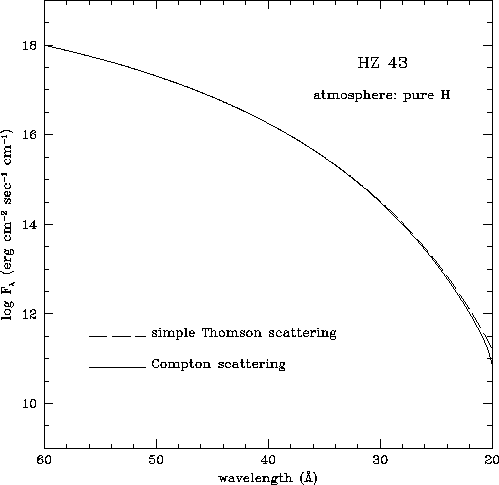
Emergent spectra in the 20-60 Å range from these new calculations
are illustrated in Figure 3. These calculations are in
good agreement with those of Suleymanov (Figure 2),
indicating that Compton flux suppression amounts to a factor of 2 or
less at 20 Å. Such differences are in fact much smaller than the
predicted uncertainties resulting from uncertainties in the current
knowledge of the fundamental parameters of HZ43. The spectrum in
this Wien tail region is especially sensitive to uncertainties in the
effective temperature.
Figure 3:
Emergent spectra for a pure hydrogen model atmosphere
appropriate for the parameters of HZ43 computed for classical Thomson
scattering (dashed) and Compton scattering (solid) by Jerzy Madej
(private communication)
using the method of Madej et al. (2004,ApJ,602,904).
 |
Madej attributes the large differences between his earlier
and present calculations to the different numerical approaches
adopted, and to inadequacies in the approach used in the earlier
work. He was able to confirm that the method adopted for the 1998
paper did indeed lead to overestimation of the flux suppression at
shorter wavelengths.
New calculations by two independent workers using rigorous numerical
methods confirm the effects of Compton energy redistribution in
photon-electron scattering events are completely negligible for the
interpretation of X-ray spectra of DA white dwarfs such as Sirius B
and HZ43. The large flux suppression at  Å predicted for HZ43-like models by Madej (1998) appear to be spurious
and are convincingly explained by impropriety of computational expedients
employed in those calculations.
Å predicted for HZ43-like models by Madej (1998) appear to be spurious
and are convincingly explained by impropriety of computational expedients
employed in those calculations.
On the relevance of Compton scattering for the interpretation
of spectra of the LETGS DA white dwarf standard candles HZ43 and
Sirius B
This document was generated using the
LaTeX2HTML translator Version 2002-2-1 (1.70)
Copyright © 1993, 1994, 1995, 1996,
Nikos Drakos,
Computer Based Learning Unit, University of Leeds.
Copyright © 1997, 1998, 1999,
Ross Moore,
Mathematics Department, Macquarie University, Sydney.
The command line arguments were:
latex2html -split 0 compton.tex
The translation was initiated by Jeremy Drake on 2005-10-03
Jeremy Drake
2005-10-03